
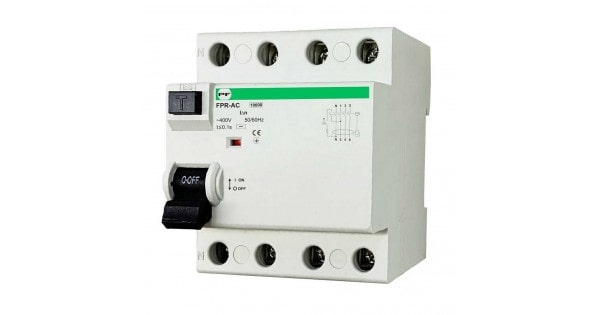
Differential relays and differential circuit breakers are very similar devices. They differ in design and operating principle. Let’s examine their features and differences in more detail.
Basic Characteristics
A differential relay is a device that protects consumers from electric shock upon direct contact with a conductive surface. For example, an uninsulated wire, an electrical appliance whose casing is energized.
Differential relay – devices necessary for fire protection on equipment with damaged insulation and faulty wiring. These RCDs disconnect the circuit when a current imbalance occurs in the wiring.
Industry produces two types of differential relays:
- Type AС. These relays are designed to respond to leakage of sinusoidal alternating currents.
- Type A. Intended for installation in circuits powering equipment that includes rectifiers or thyristors. That is, where leakage of both direct and alternating current occurs in case of insulation failure. Installation instructions for such relays are found in the operation manuals of some household appliances.
How does a differential relay differ from a differential circuit breaker?
A differential relay or RCD with a differential circuit breaker has some similarities, especially externally, but their operating principles differ significantly. A differential relay involves instantaneous vector analysis of the current in the phase – 0.
If the sum of the vectors differs from zero, the mechanism receives a signal to disconnect the circuit, i.e., it reacts to leakage of electric current. A differential circuit breaker responds to so-called overload currents, which occur during overloads and short circuits, although some of these devices also react to ground leakage, performing the functions of both a circuit breaker and a relay.
Since differential relays and circuit breakers are incredibly similar, it is quite difficult for an amateur electrician to distinguish them – knowledge of markings is necessary. Also, the installation of devices capable of protecting against fires and, consequently, ensuring life and health safety, is better entrusted to qualified professionals.
These units are mounted after the main meter in the electrical panel on a DIN rail. At 220 V, they have two terminals on the input and two on the output. At industrial sites and in places where 380 V is supplied, four terminals are installed on the input and output. These nuances must be taken into account for proper device operation.
![[Exclusive] Noise Master Series: Review of flagship headphones](https://teranews.net/wp-content/uploads/2025/09/frame_19522-360x220.webp "[Exclusive] Noise Master Series: Review of flagship headphones")