
Every person involved with IT or planning to create a website for personal needs has encountered terms like “hosting” and “VPS.” The first term “hosting” is clear – it’s the place where the website will be physically hosted. But VPS raises questions. Considering that hosting usually implies a cheaper option in the form of a tariff plan.
A person unfamiliar with IT technologies might ask – why do they need to understand the details of virtual and physical servers? The answer lies in two factors:
- Financial expenses for maintaining a website on hosting. Hosting is paid. Monthly, you need to pay at least $10 for a tariff plan or $20 for a VPS service. Renting a physical server starts at around $100 per month.
- Website performance. Fast page loading and availability at any time.
If these criteria (cost savings and website performance) are not important to you – this article is not for you. For others, let’s continue.

Renting a Virtual Server (VPS) – What It Is, Features
To make it easier to understand, imagine a personal computer or laptop with a certain amount of disk space. This space can be used to store files of a single website. Photos, documents, code files – all the small files used for website operation.
It turns out that the computer acts as a hosting for the website. And accordingly, it uses all the resources of a mobile or desktop computer. These include:
- Processor.
- RAM.
- Persistent storage.
- Network bandwidth.
If the website is large (for example, an online store) and has many visitors at a time, then resource allocation makes sense. But if it’s a business card site, then all the above resources will be idle. Why not run several sites on such an “underloaded” computer?

Again, imagine a computer running several different sites in structure and load. For example, a business card site, a catalog, and an online store. In this case, system resources (processor, RAM, and network) will be unevenly distributed among the sites. The online store, with its payment modules, will take 95-99% of resources, while other sites will “hang” or “slow down.” Therefore, it’s necessary to properly distribute the computer’s resources among the sites. This can be achieved by creating multiple virtual environments on a physical server.
What Factors Are Considered Decisive When Choosing a VPS
Price and performance are the main criteria for the renter (service buyer). Renting a virtual server begins with selecting resources for the existing website hosting. These include:
- Hard drive size. Not only the space for files is considered but also the possibility of expanding the site, for example, by adding new images or videos. Plus, another point – email. If you plan to run an email server on the domain, you need to calculate free disk space. About 1 GB per email account, at least. For example, if website files occupy 6 GB and there are 10 email accounts, then you need at least 30 GB of disk space, preferably 60 GB.
- RAM size. This parameter is specified by the developer who created the site from scratch. The platform, installed modules, and plugins are taken into account. The required RAM can range from 4 to 32 GB.
- Processor. The more powerful, the better. Usually, Intel Xeon processors are used in servers. Look at the number of cores. 2 cores are already good. More cores – everything will run faster. This indicator is also specified by the developer.
- Network bandwidth – from 1 Gbps and above. Less is not desirable.
- Traffic. Some hosting providers limit the customer’s traffic. Usually, this indicator is more of a formality. If exceeded, no one will scold heavily. The website owner might conclude that the site has more visitors than expected, and increase the server’s performance to avoid losing clients.
Which Hosting Is Better for Renting a VPS
One thing is when a company offers hosting services at favorable financial conditions. And another is when full service is provided. Renting a VPS server should be accompanied by a list of capabilities such as:
- Availability of administrators who can install and launch the website on their side. This is relevant for tenants who do not have their own administrator. The provider should have specialists capable of quickly and efficiently launching the site. Naturally, if the programmer created a working site and demonstrated its operation on another hosting. Generally, transferring a site to a VPS server should be performed by the creator of the site. But there are exceptions, such as when changing hosting providers.
- Availability of a control panel. It’s desirable to have several options, such as cPanel, VestaCP, BrainyCP, etc. This makes resource management easier, especially for managing email servers.
- 24/7 service. This includes restoring the site from backups, installing PHP updates, or database updates. The thing is, some updates in the site management panel require compatibility on the VPS server.
- If it’s a VDS server rental, access to OS kernel management and the ability to install special software should be available.
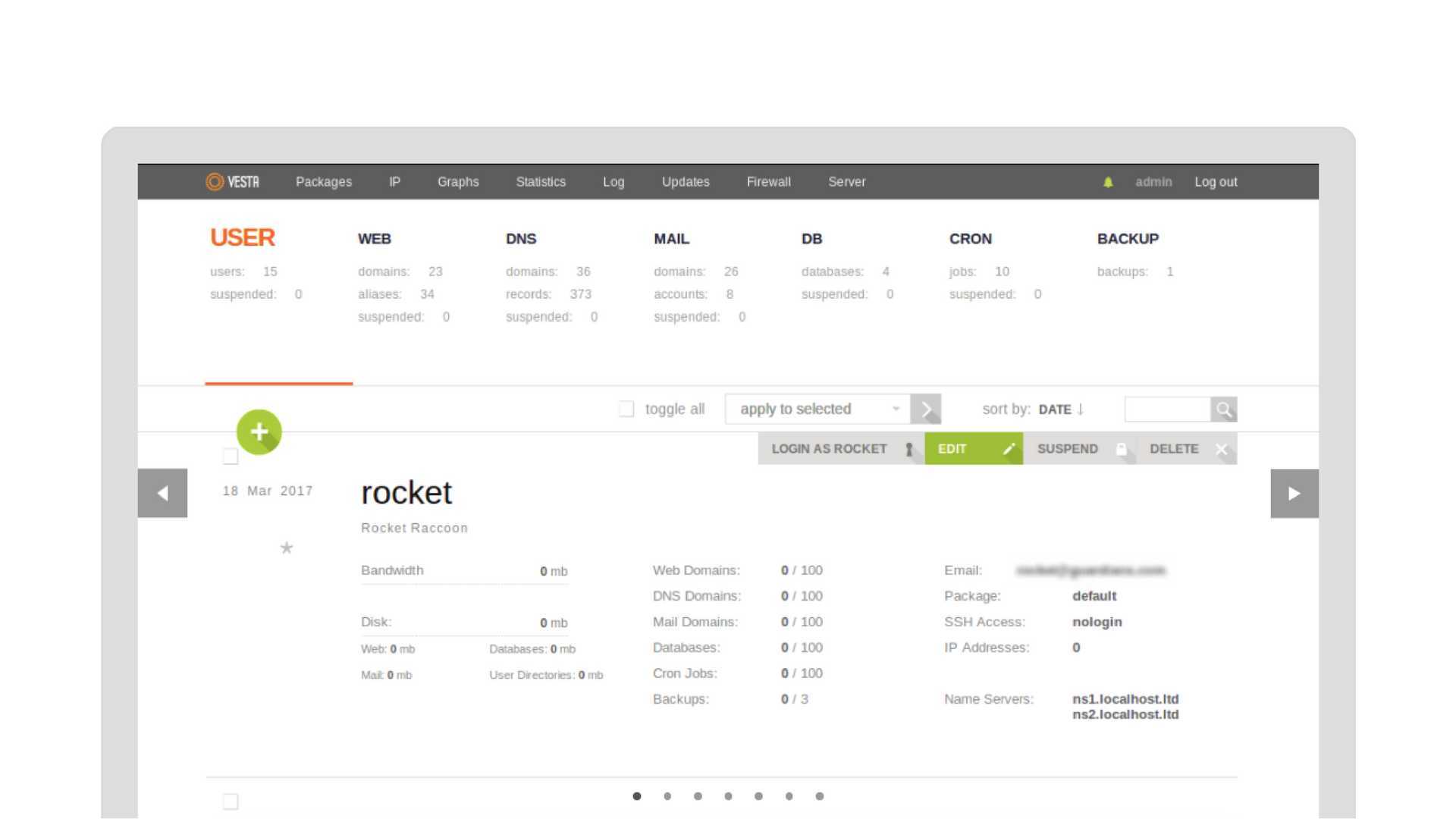
It’s also very convenient when the hosting provider offers domain registration or transfer services. In the first case, you can immediately choose a domain, purchase it, and launch the website right away. Plus, you can pay for the domain and hosting with a single payment, for example, annually. In the second case, if the domain was purchased elsewhere, such as during a promotion, it’s better to transfer it to the same provider where the website is hosted. This simplifies payments and overall management.