Choose a lure box to fit both the tackle you actually take fishing and the bag compartment where you plan to carry it. A long hard bait needs a compartment of sufficient length; a bulky lure with hooks needs enough clearance beneath the lid. A larger case does not automatically solve both problems: its compartments may be too short, while catches and latches take up space in your bag. Start with measurements and a small working set, rather than the compartment count in a product title.
This article contains affiliate links. TeraNews may earn a commission on purchases made through them, at no additional markup to you.
First, check the case dimensions, dividers and lid. Then consider three empty-box options from AliExpress. They may suit different storage needs, but the available seller titles do not establish their exact outer dimensions, usable depth or divider layout. Treat them as options to investigate, not as proof that a particular lure or tackle set will fit.
Measure your bag and the most awkward lures first
Gather the tackle for a typical trip and identify your longest and tallest lures. Check each one in the condition in which it will go into the box, including fitted hooks and any protruding parts. The lure body’s length alone does not tell you whether the lid will close or whether the hook will stay within its compartment. Record the required compartment length, width and height separately so you can compare them with the listing.
Measure not only the inside of the bag but also the opening of the compartment you intend to use. You need to get the box in and out through that opening, so a base that fits does not guarantee a convenient fit. If you plan to carry several boxes, decide how they will sit or stack. That helps you work out whether you need more depth in one case or would be better off splitting the tackle between shallower ones.
In its FAQ, Plano warns that outer dimensions can vary slightly even within one size range because of lids, latches and other design features. For a separately purchased box, the manufacturer recommends measuring it, and checking compatibility with a bag against the bag’s stated dimensions and designation. A series number can help with searching, but it does not replace checking the dimensions of the specific item.
Look for two distinct sets of measurements in a listing: the box’s outer dimensions and the inside dimensions of its compartments. The first set tells you whether it fits in your bag; the second, whether your lures fit inside it. If a seller provides a diagram without explaining which dimensions it shows, do not assume the two sets are interchangeable. This matters especially in boxes with several rows: the case’s overall length says nothing about the length of an individual compartment.
Choose dividers for your tackle, not for the compartment count
Plano distinguishes between boxes with fixed compartments and those with movable dividers. Fixed compartments make sense when you already know your set and it fits the existing layout. Movable dividers can help when you switch between lures of different lengths, within the limits of the design. The word “adjustable” does not necessarily mean you can remove every wall inside the case.
A range in the compartment count also needs careful reading. As Plano explains, it refers to different layouts: the more compartments you create, the smaller each one becomes. A high compartment count therefore does not mean more room for long lures. For those, the key is the available length after dividers are installed; for small tackle, it is whether you can separate items into useful groups.
Check the internal layout before buying. Find out which walls are fixed, where removable dividers slot in and what remains when they are removed. If a fixed crosswall cuts across the space needed for a long lure, moving shorter dividers will not solve the problem. For small tackle, check how the dividers meet the base and closed lid: a large number of sections by itself does not show that contents will stay separate.
Do not assume one box has the same features as another because the photos or names look similar. Available information does not establish that the options below have movable dividers. If this feature is essential, ask for confirmation about the specific option before buying. Do not count on changing the internal layout without that information.
When you need depth, and when a second box is more useful
Sport Fishing’s article on tackle-box design discusses shallow, deep, double-sided and two-level options as different ways to organise tackle. A double-sided design does not, by itself, show that either side is deep enough for a bulky lure. Check the usable height of each compartment, rather than relying on the closed case’s overall thickness.
A shallow case can work for tackle that does not need much clearance. The Wired2Fish guide to organising tackle describes using small boxes as modules for specific trips, avoiding extra bulk where it is not needed. This is a useful starting point if you fish with a limited set and change it to suit the trip.
Look for a deep box when your measurements show that your lures need the extra height. If most of your set is small and flat, extra depth does not automatically provide better organisation. Before buying, decide what will use that space. If the answer is spare tackle “just in case”, consider whether it would be more convenient to keep it at home in a separate module.
A double-sided format can hold two planned groups, such as lures for different purposes. It may suit you if you want one case with two storage areas. If you regularly leave one group at home, two separate boxes give you more flexibility over what goes in your bag. Your fishing routine matters more than fitting the highest possible compartment count into one item.
A sealed lid and drying tackle solve different problems
Read “waterproof” in a seller’s listing as a claim about the product, not as the result of an independent test. It does not establish what kind of contact with water the box can withstand or guarantee that its contents will stay dry. If protection from external moisture matters for how you carry your tackle, ask about the lid, seal and stated conditions of use for the specific option.
There is another side to the issue. In the Sport Fishing article, a brand representative explains that a sealed, waterproof box can trap water brought in by wet lures. A tight seal therefore does not replace drying. Do not choose a sealed design on the assumption that wet tackle can simply be put away and left closed for a long time.
The same article describes ventilated Hydro-Flo boxes as a separate design with openings for drying. Ventilation should not be presented as airtightness: openings for airflow mean a different approach to storage. Decide first whether you prioritise limiting external water or allowing airflow, then check that the case has the relevant design. Available information does not establish that any of the options below has ventilation.
Claims about corrosion protection also call for caution. In the source, these are statements from manufacturers and their representatives, not independent comparative test results. For everyday organisation, it is more useful to set aside a place for used wet lures and open them to dry after a trip. Do not treat packaging claims as a substitute for that routine.
What to check in the specific listing
Do the general checks before ordering. A listing title may cover several options, and a SKU alone does not explain their dimensions or contents. Check that the stated compartment count matches the option you select. This selection has no confirmed measurements or test results that would allow the boxes to be ranked for capacity, watertightness or durability.
- Compare the selected option’s outer dimensions with the bag compartment and its opening.
- Ask for the usable compartment dimensions needed by your longest and tallest lures.
- Check which dividers can be removed and which walls are fixed.
- Confirm that the compartment count and pictured layout apply to the option you select.
- Check that the listing is for an empty box and confirm how many items are included.
- If the seller claims the box is waterproof, ask how the seal works and what conditions of use are specified.
Three options for different storage needs
Double-sided box listed with 14 compartments
The seller’s title describes this option as double-sided with 14 compartments. Consider it if you want to sort a set into separate sections, for example by lure type. The layout is the deciding factor: if you need several long compartments, compare it with your tackle before deciding whether the two-sided format is useful.

Price checked 29.11.2026: 1.38 GBP
Sold: 14437+; Buyer rating: 95.1%
View on AliExpress
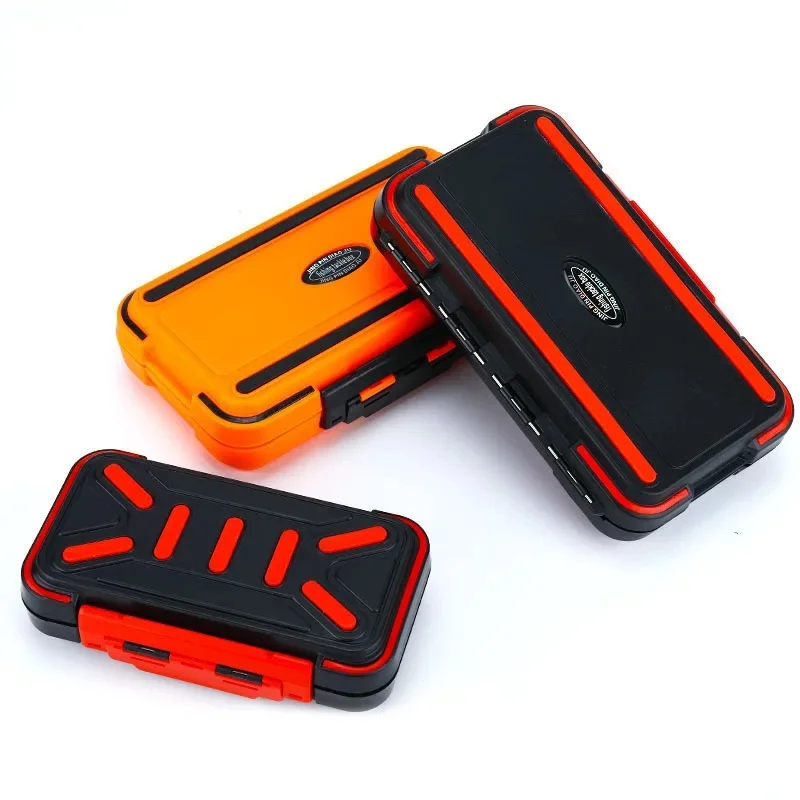
Double-sided box with a waterproof claim
The seller describes this option as double-sided and waterproof. It may be worth considering if you want two storage areas and are concerned about external moisture. Base your choice on confirmation of the lid and seal design; you will still need a separate way to dry used lures.
Price checked 29.11.2026: 6.22 GBP
Sold: 9561+; Buyer rating: 98.0%
View on AliExpress
Box listed for small tackle
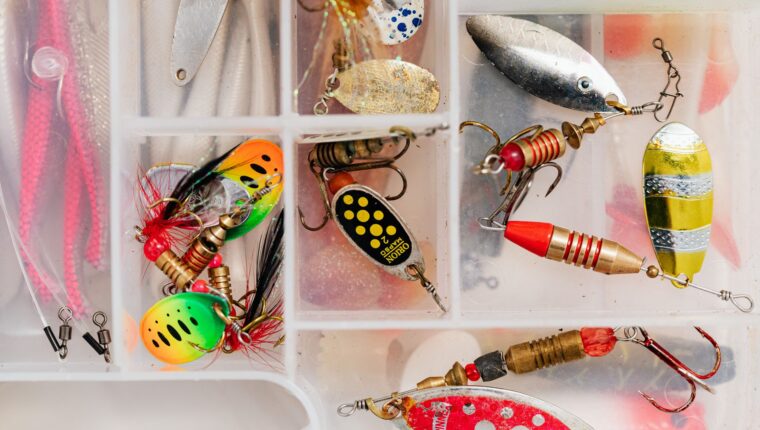
The seller’s title lists swivels, jigs, hooks and sinkers, and describes the box as having 10 compartments. Its possible role is as a separate module for small tackle, so you can choose those items independently of your main lure set. If you plan to put it inside a larger container, check both sets of dimensions and make sure the outer lid can still close.

Price checked 29.11.2026: 1.47 GBP
Sold: 8124+; Buyer rating: 98.0%
View on AliExpress
Make the choice without carrying unnecessary spares
Start with a simple sketch: list the lures for your next trip and assign them to the compartments you need. If most fit in small sections, look for a suitable layout and only the clearance you need. If one long lure determines the choice, find a compartment that fits it first. The total number of sections is secondary.
For several working sets, labelling boxes by purpose can help; Wired2Fish describes the same approach. You can then pick the modules you need instead of transferring all your tackle each time. Before ordering, check three things: the box fits your bag, your tackle fits its actual compartments, and you have a clear way to separate and dry used tackle after fishing.
This is the AliExpress catalogue price for the selected market when checked. Confirm stock, variant, delivery, taxes and the final total before paying.