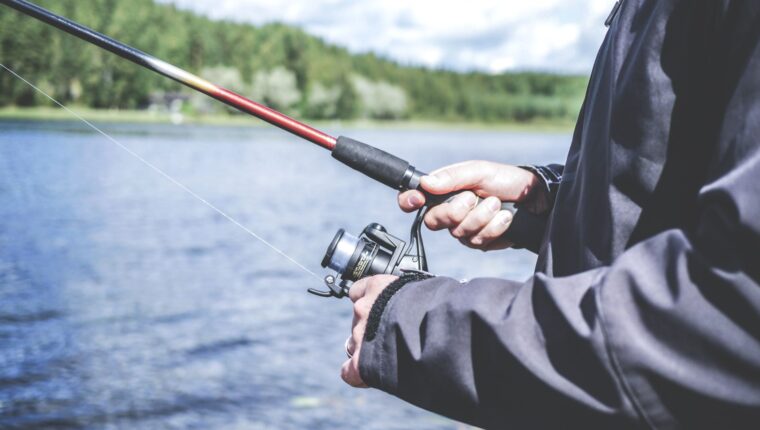
A spinning rod looks like a simple stick with rings until you open a tackle shop: the blank is marked UL, ML or MH, numbers like 5-25 g, and words like fast and moderate, while prices differ tenfold. Yet the right choice decides whether your lure lands where you want it and whether you feel the bite. We go through which parameters to look at, drawing on advice from Rapala and angling guides, and at the end show six popular models from AliExpress.
This article contains affiliate links. If you buy something through them, the site earns a small commission from AliExpress, and the price you pay stays the same.
First, answer two questions
What you are fishing for, and where. Perch on a small river from the bank and pike from a boat on a reservoir call for different rods, and there is no all-purpose option. Everything else depends on the answer: length, power and action.
Length
A short rod gives more control and accuracy, while a long one casts further. As a guide:
- From a boat: up to 2.4 m, and on narrow rivers and small lakes up to 1.8 m. Rapala notes that rods from 152 to 213 cm are easier to handle in a boat or kayak.
- From the bank: a comfortable range is 2.14 to 2.75 m. On big water, or when casting from a high bank, people use 2.5 to 3.3 m.
- In thick cover or on overgrown banks: up to 2.13 m, otherwise a long blank is awkward to work between bushes.
If in doubt, Rapala suggests starting at about 7 feet, which is around 2.1 m.
Casting weight: what lure weight the rod can throw
The casting weight is printed on the blank in grams, for example 5-25 g. This is the range of lure weights the rod handles properly. A blank that is too soft is hard to control with a heavy lure and can break, while one that is too stiff struggles to cast light lures. By class it looks like this:
- UL (ultralight): 0.5 to 7 g, usually up to 2.1 m long, for fish up to about 1.5 kg. Perch, trout and chub on micro lures.
- L (light): 3 to 10 g, 2 to 2.5 m long, fish up to 2 kg.
- ML (medium light): 5 to 25 g, the most versatile class.
- M (medium): 7 to 28 g, for larger waters.
- MH (medium heavy): 10 to 35 g or 15 to 40 g, up to 3.3 m long. Pike, large perch, salmon.
- H (heavy): 20 to 50 g, for the sea and big catfish.
For an all-round rod, Rapala suggests a casting weight of about 10-30 g or 15-40 g, for perch 5-25 g, and for jigging and zander 15-40 g.
Action: how the blank bends
Action shows which part of the rod bends under load.
- Extra fast: only the top quarter bends. Good for twitching crankbaits.
- Fast: the top third bends. Suits twitching and jigging, and gives sensitivity and a confident strike on a single hook.
- Moderate: about half bends. Smoother and more versatile, and more forgiving of mistakes with treble hooks.
- Slow: almost the whole blank bends. Suited to micro jigging and light lures, but the strike is weaker.
A fast action gives a more accurate cast, a slow one a longer cast. Rapala recommends a fast action for pike, jigging and zander, and a moderate-fast or fast action for perch.
Blank material
Fibreglass is the cheapest and most flexible, but heavy. Carbon (graphite) is the lightest, stiffest and most sensitive, but costs more and dislikes knocks. Composite, a blend of carbon fibre and fibreglass, ends up fairly light, strong and inexpensive. For a first rod, composite or inexpensive carbon is the best choice. Labels like 30T or 40T in the name refer to the grade of carbon fibre but guarantee nothing on their own: casting weight, action and buyer reviews matter more.
Rings, handle and construction
Rings. Cheap models sometimes have plastic rings, which braided line can simply saw through. Choose metal rings with ceramic inserts and check for chips and cracks. If Fuji appears in the name, those are rings from a well-known Japanese manufacturer.
Handle. It may be EVA, neoprene, polyurethane foam or cork. Cork is usually found on pricier models, and EVA is a little lighter. Here it comes down to how it feels in your hand.
Telescopic or multi-piece. Telescopic rods are cheap, compact and suit beginners, but their joints wear over time from sand and dirt. Multi-piece rods in 2, 3 or 4 sections are more reliable and more popular, although longer when packed. Travel models in 4 or more sections fit in a rucksack.
Reel. Rapala advises beginners to start with a fixed-spool reel and to try it on the rod before buying: the combination should sit balanced in the hand.
Popular spinning rods from AliExpress
Below are the six models people buy most. Specifications are taken from the product titles. Prices as of 14 November are for the base variant: on most models you can choose the length and casting weight on the product page, and the price changes accordingly.
BIUTIFU Traveller with Fuji rings, 5-42 g
A fast-action carbon travel rod in lengths from 1.8 to 3.0 m with Fuji rings, now £15.89 (was £41.52). The wide choice of variants lets you take an ultralight for perch or a more powerful version for pike. A good candidate for a first, all-round rod.

Price on 14 November: £15.89
Sold: 4501+ pcs, positive reviews: 95.3%
View on AliExpress
LEYDUN Black Creek
A two-piece ultralight carbon fibre rod in 1.5, 1.68 or 1.8 m, at £15.90 (was £39.73). It is a short model for small rivers, streams, fishing from a boat and light lures. Sold in the brand’s official store.

Price on 14 November: £15.90
Sold: 4920+ pcs, positive reviews: 96.4%
View on AliExpress
BAKAWA, telescopic carbon
The most affordable option in the selection, at £4.39 (was £8.78): a light carbon fibre telescopic rod in lengths from 1.5 to 3.0 m. Handy to keep in the car or take on a trip just in case. For serious predator fishing a multi-piece blank is better, but for getting started and casual fishing it is enough.

Price on 14 November: £4.39
Sold: 6163+ pcs, positive reviews: 98.0%
View on AliExpress
Seasir Salminus XF M/MH with Fuji O rings
A four-piece travel rod, 1.83 m long, with Fuji O rings, now £25.58 (was £70.00). Power is M or MH, so this is a model for heavier lures and bigger fish such as pike. The seller quotes a resistance of 7 to 9 kg.

Price on 14 November: £25.58
Sold: 2666+ pcs, positive reviews: 97.4%
View on AliExpress
Seasir Riveria UL
An ultralight in lengths from 1.5 to 1.98 m with ceramic Fuji O rings and a blank of 30T and 40T carbon cloth, now £17.29 (was £46.22). A model for perch, trout and chub on light lures, where sensitivity matters. Treat a blank like this with care.

Price on 14 November: £17.29
Sold: 1706+ pcs, positive reviews: 95.0%
View on AliExpress
Combo: telescopic rod with reel
A ready-made set of a carbon telescopic rod in lengths from 1.8 to 3.6 m and a reel, at £15.41 (was £37.68). A solution for those who want to try spinning without choosing a reel separately, or a gift for a beginner. An experienced angler will quickly outgrow a set like this.

Price on 14 November: £15.41
Sold: 3077+ pcs, positive reviews: 98.0%
View on AliExpress
Quick cheat sheet
- Perch and trout on a small river: UL or L, 1.8 to 2.1 m, fast action.
- All-round rod from the bank: ML, about 2.1-2.4 m, casting weight roughly 5-25 g.
- Pike and jigging: MH, casting weight 15-40 g, fast action.
- For travel: a 4-piece travel model or a telescopic rod.
- Always: rings with ceramic inserts if you plan to use braid.