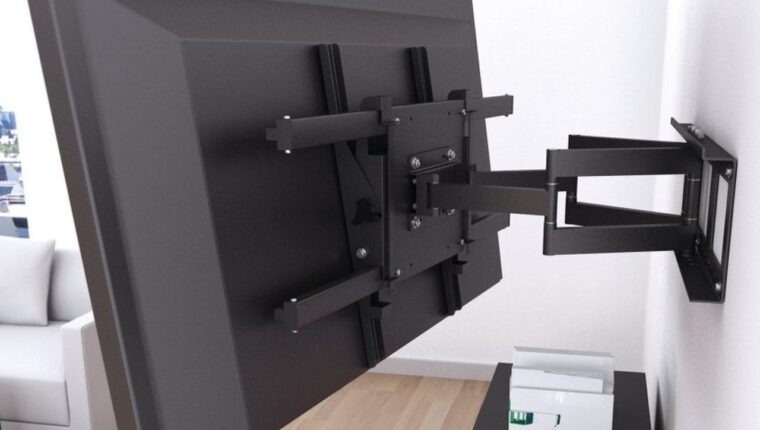
Before the advent of flat liquid crystal panels, televisions were bulky and heavy. Because of this, there were not many options for their installation: most often, the equipment was installed on a cabinet. The resulting structure took a lot of time and often did not fit well into the existing interior. But time went on, and now you can only see an old television in Khmelnytskyi with an antique connoisseur. Most people prefer to buy flat and lightweight panels that look stylish and elegant.

But even the thinnest and most elegant television needs to be somehow placed in the room. You can use a cabinet, but this is not the best option. It is much more convenient and practical to fix the equipment on a special bracket. Buyers are offered wall-mounted and ceiling mounts of various configurations. In our article, we will consider the available range of products and try to clarify the features of each type of bracket.
What are TV brackets and their main types
These are devices that allow you to securely fix the equipment on the wall or ceiling. To ensure the structure has sufficient strength and resistance to deformation, they are made of steel, and to protect against corrosion, they are painted with special metal paints. Steel brackets are quite heavy, so when installing them, it is necessary to consider the wall’s ability to withstand large loads.
Mounts perform several important tasks:
- Help harmoniously integrate the equipment into the interior;
- Promote saving living space;
- Ensure comfortable use of the equipment;
- Securely and reliably fix the television.
Depending on the surface on which they can be fixed, there are ceiling and wall models. You can familiarize yourself with the assortment of televisions in Khmelnytskyi in the ALLO catalog. In turn, these types are divided into:
- Fixed. They do not allow changing the position of the screen. With them, the television will always be in the same position you provided during installation. Therefore, it is important to consider all nuances during installation, as changing the position of the equipment will be problematic.
- Tilt. These models allow changing the tilt angle of the display relative to the horizontal. This is convenient, for example, if the television is located opposite a window or other light source. Tilting the display can eliminate glare that hinders viewing.
- Tilt-rotatable. These brackets allow adjusting the position of the screen in multiple planes. This guarantees a comfortable viewing experience from any corner of the room.
When choosing brackets, it is important to pay attention to their size, material, permissible weight of the equipment being installed. It is also crucial that the surface on which the mount is fixed has sufficient load-bearing capacity. For example, it is not recommended to mount brackets with a television on drywall partitions, as the entire structure may collapse under their weight.