You buy a dash cam once and think about it only when the footage is really needed: after a collision, a dispute in a car park or a conversation with your insurer. That is exactly when you find out that the neighbouring car’s number plate is blurred, the night footage is mush, or the file was overwritten. Here is which specifications genuinely affect the quality of your evidence and which are just marketing, along with five good 70mai and DDPAI models from AliExpress.
This article contains affiliate links. If you buy something through them, the site receives a small commission from AliExpress, and the price you pay does not change.
The sensor matters more than the resolution
The most common mistake is choosing a dash cam by the “4K” figure on the box. Resolution determines how many pixels are in the frame, but how informative those pixels are depends on the sensor. It is the sensor that decides whether a plate is readable at dusk, in the rain or in the glare of oncoming headlights.
Sony STARVIS 2 sensors are currently the benchmark for dash cams. The IMX678, for example, has a 2.0 µm pixel, whereas many budget sensors sit at around 1.4 to 1.7 µm. The larger the pixel, the more light it collects and the less noise you get in night footage. That is why a good 2K dash cam on a quality sensor often beats a cheap 4K one. If a manufacturer does not name the sensor model, treat it as a warning sign.
The second important optical spec is the aperture. The smaller the number after f/, the faster the lens. Values around f/1.5 and f/1.6 are a good level for night shooting today.
HDR and WDR: protection against glare
Roads constantly throw up scenes with a big brightness range: leaving a tunnel, a low sun, headlights in the dark. WDR and HDR even out the exposure so that both bright and dark parts of the frame stay readable. For a dash cam this is a necessity, not an option: a car’s number plate in the glare of headlights is the thing most often blown out.
Viewing angle: wider is not always better
Dash cam viewing angles typically range from 70 to 180 degrees. A wide angle captures neighbouring lanes and the verge, but distortion appears at the edges of the frame and objects become smaller. The best compromise for a front camera is usually around 140 to 150 degrees: enough to see several lanes while the plate of the car ahead stays reasonably large.
One, two or three cameras
If someone drives into the back of you, the rear camera footage will be your key evidence, so its resolution should not be neglected either. 1080p at the rear is now the standard for dual-channel systems, and pricier models sometimes offer 2.5K. Bear in mind that when recording on two channels at once, some inexpensive dash cams lose noticeable quality, so it is better to choose models where both resolutions are stated explicitly.
A third camera pointing into the cabin is needed mainly by taxi and car-sharing drivers; for an ordinary car it is more of an extra.
A supercapacitor instead of a battery
This is an underrated but very important point. A dash cam hangs under the windscreen, where the cabin bakes in summer and freezes in winter. Lithium-ion batteries cope badly with such conditions: above 50 to 55 °C they begin to degrade, and when overheated beyond 70 °C they can swell. Supercapacitors are far more resistant to extreme temperatures and last significantly longer, often longer than the dash cam itself.
The capacitor has one drawback: it stores energy for only a few seconds, enough to save the last file properly after the power is cut. But for a dash cam that runs off the car, that is all it needs. Choose models with a supercapacitor, especially if your car often sits in the sun.
Parking mode
Parking mode records what happens around the car while the engine is off. To work, the dash cam must be wired directly into the car’s electrical system with a dedicated hardwire cable. That cable monitors voltage and switches the dash cam off when it drops to roughly 11.8V, so the car’s battery is not drained. For some models the hardwire kit is sold separately, so factor it into your budget.
GPS, Wi-Fi and the memory card
GPS embeds coordinates and speed in the video, which is useful when reconstructing the circumstances of a collision. Wi-Fi lets you view and download footage to your phone without removing the dash cam or taking out the memory card. Wi-Fi 6 and the 5 GHz band noticeably speed up the transfer of large 4K files.
Do not economise on the memory card. When recording in 4K, a 64 GB card fills up in about 4 to 6 hours of continuous recording, so a sensible minimum is 128 GB, while 256 GB lasts about a day of recording before looping begins. Buy cards designed for continuous recording and format them periodically in the dash cam itself.
Five good models from AliExpress
All the models below are sold in the official 70mai and DDPAI stores and have 1,200 or more sales. Specifications come from the manufacturers’ descriptions, and prices are as of 16 October.
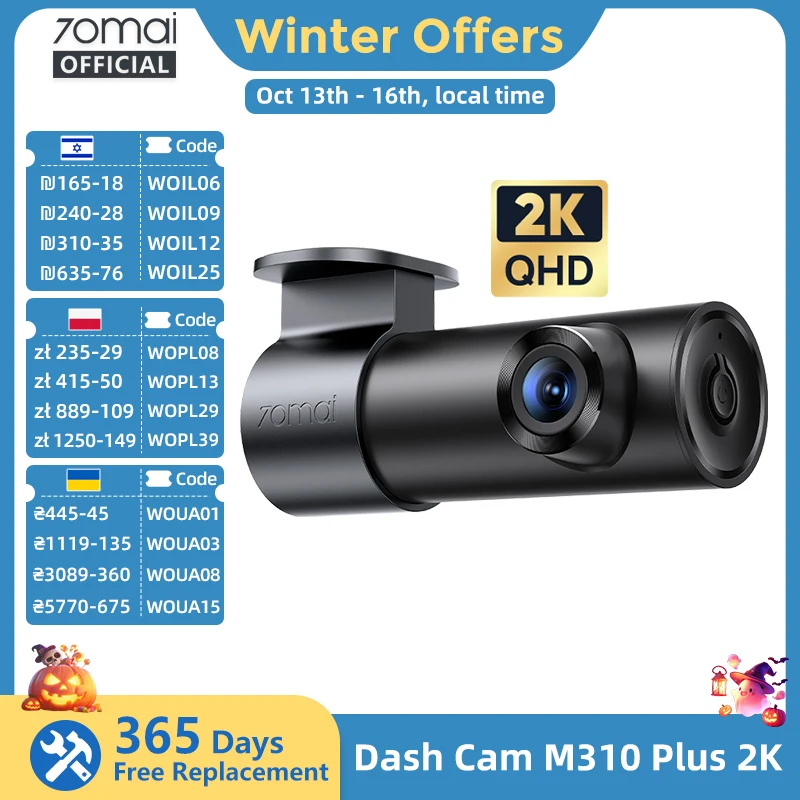
70mai M310 Plus 2K: fast optics for a small price
The best-selling model on the list. 2K (1440p) resolution, a 143 degree viewing angle and an f/1.55 aperture lens, which is rare at this price. It has voice control and parking guard.
Price on 16 October: £30.40
Sold: 5504+ pcs, positive reviews: 96.4%
View on AliExpress
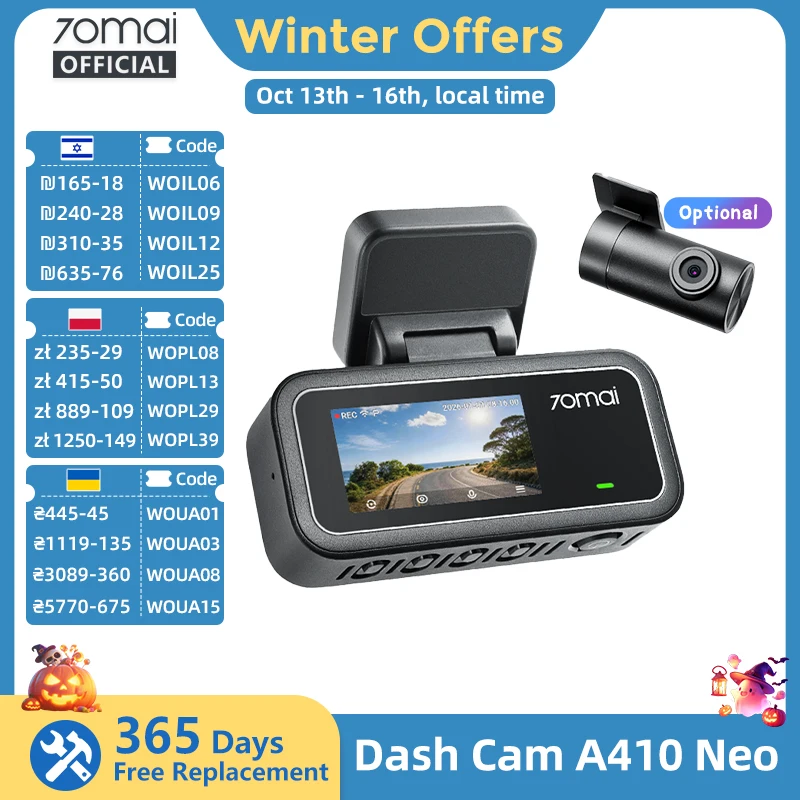
70mai A410 Neo: two cameras, GPS and a supercapacitor
A dual-channel dash cam with 1440p resolution, HDR, an f/1.6 lens, built-in GPS, Wi-Fi 6 and a supercapacitor. It supports a 24-hour parking mode. On total specifications it is arguably the most balanced option for most drivers.
Price on 16 October: £52.79
Sold: 1225+ pcs, positive reviews: 97.6%
View on AliExpress
DDPAI Z50 Pro: 4K at the front and 1080p at the rear
A kit with a 4K front camera with HDR and a 1080p rear camera. It offers night shooting, Wi-Fi 6, GPS, an ADAS assistant and 24-hour parking monitoring. A sensible step up if you want maximum resolution at the front.
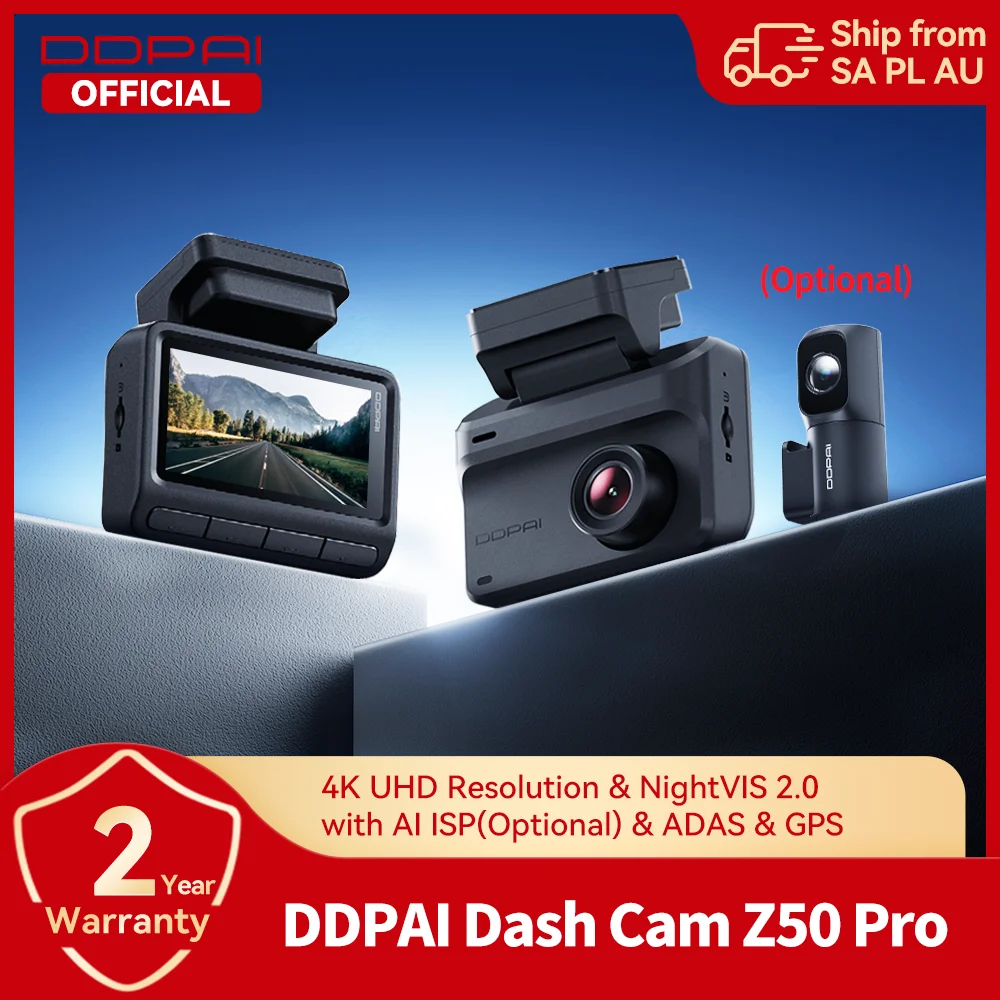
Price on 16 October: £73.00
Sold: 2400+ pcs, positive reviews: 96.6%
View on AliExpress
70mai T800E: three cameras for taxis and car sharing
A three-channel system: a 4K front camera, with 1080p rear and cabin cameras. It has HDR, a supercapacitor, 24-hour parking mode, GPS, voice control and Wi-Fi 6. If you carry passengers, the cabin camera is useful for settling disputes.
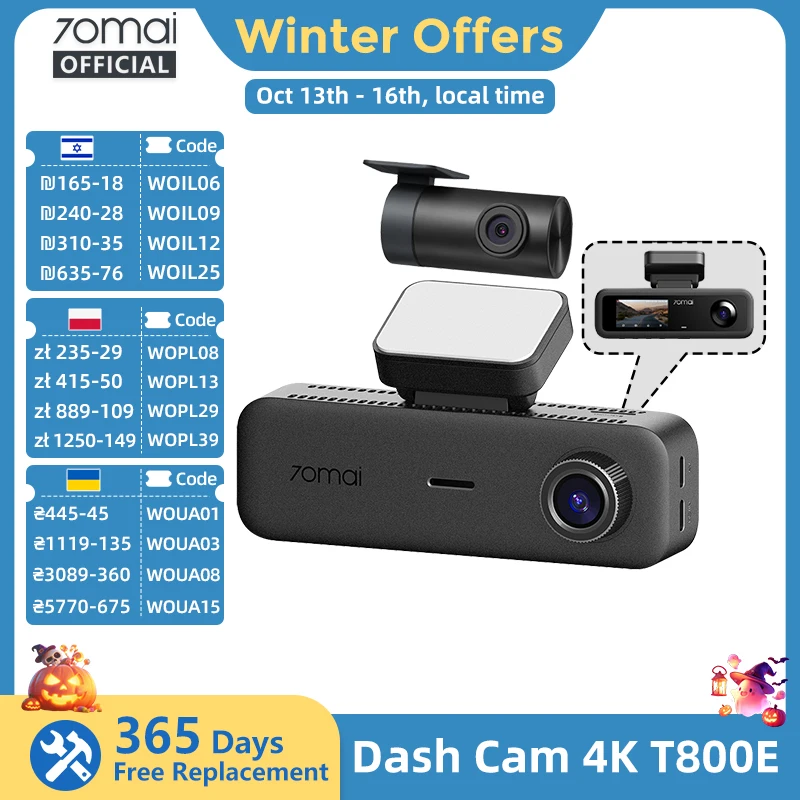
Price on 16 October: £142.19
Sold: 6096+ pcs, positive reviews: 95.3%
View on AliExpress
70mai A810S: the IMX678 flagship with 4G
The top model, built on the very Sony IMX678 sensor discussed above. The dash cam has dual HDR, a supercapacitor, Wi-Fi 6 on the 5 GHz band, GPS, ADAS and 4G LTE support for remote access. It suits those who want to see what is happening to the car in a car park while they are far away.
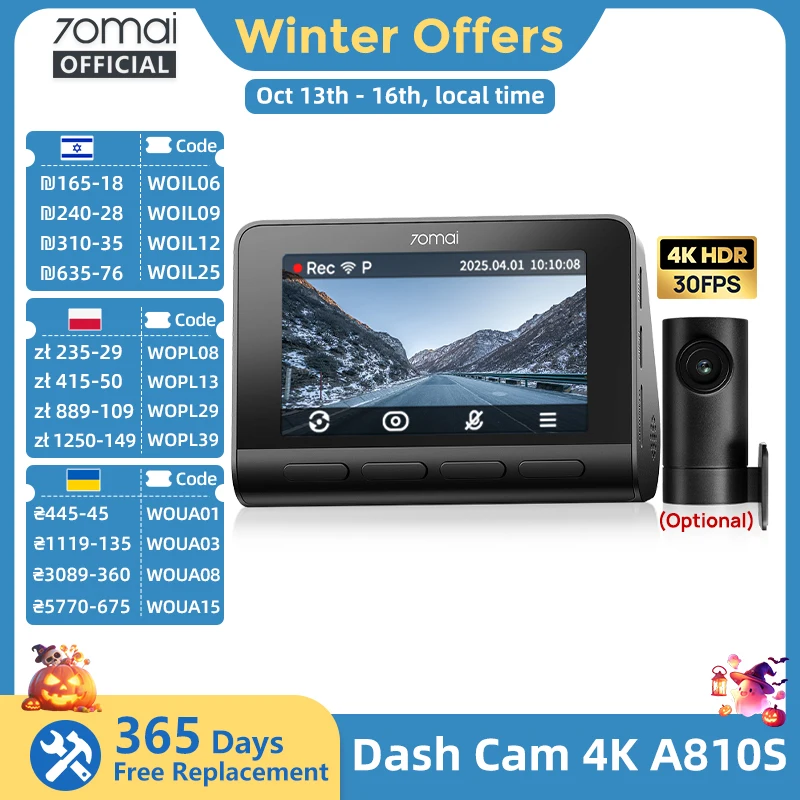
Price on 16 October: £119.99
Sold: 4461+ pcs, positive reviews: 97.0%
View on AliExpress
A quick buyer’s checklist
- The sensor model is stated, ideally Sony STARVIS 2.
- Aperture of about f/1.6 or faster.
- HDR or WDR is present.
- Power backup comes from a supercapacitor, not a battery.
- If you want rear protection, the rear camera is at least 1080p.
- For parking mode, budget for a hardwire cable.
- A memory card of 128 GB or more, rated for continuous recording.
If you want to choose without much deliberation: the 70mai M310 Plus is enough for a single camera, the 70mai A410 Neo is the best dual-channel option, and the 70mai A810S delivers the best night recording quality.